

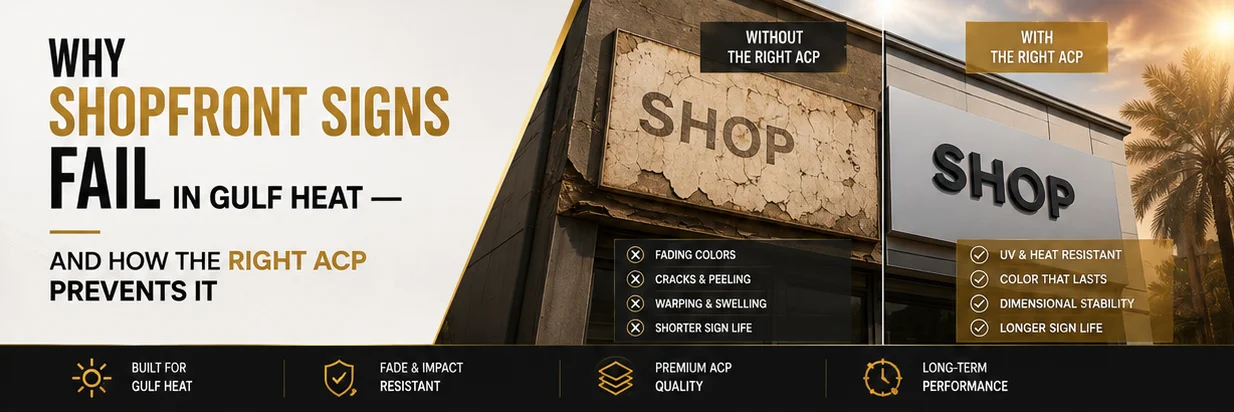
Walk down any older retail street in Sharjah or Deira and you can read the history of cheap signage: lifted edges, chalky faded colours, panels that ripple in the afternoon sun. None of that is bad luck. A shopfront here spends every summer afternoon at 60 to 80 degrees surface temperature, in humidity, under some of the strongest UV on the planet. Materials either handle that or they do not.
Delamination kills more signs than anything else
Heat cycling works on the bond between the aluminium skins and the core, day after day. A weak lamination line opens at the edges first, and once an edge lifts, the sign is done. Ask your supplier how the panel is bonded. Continuous lamination is the answer you want to hear. It is one reason we like that our panels are made here in Dubai, by people who build for this exact climate.
Colour fade is a slow embarrassment
Budget coatings chalk white and fade unevenly. The logo stays sharp while the background dies around it. A coating rated for high UV exposure keeps brand colours honest for years instead of seasons.
Ripples show at 4pm
Thin skins oil-can when hot, and afternoon light rakes across the fascia and shows every wave. Proper skin gauge plus the right thickness for the span, 3mm as standard and 4mm for the big fascias, keeps the face flat when it matters.
Metal moves. Design for it.
A 3 metre fascia panel grows several millimetres between morning and afternoon. Fixings need room to let that happen, or the panel buckles and the sign does the work of telling everyone who cut corners.
And a small one that catches people out constantly: do not leave the protective film on through a summer. It bakes on. Fit the sign promptly or ask for film rated for a longer window. Our buyer’s guide covers all of this in ordering-checklist form.